
Estimated read time: 7–9 minutes
By Ken Marcus, Owner — Oxy-Genie | Serving Calgary since 2007
Introduction
If you mop your kitchen floor and walk back in thirty minutes later to find the grout lines still look grey, you’re not imagining it. You’re also not doing anything wrong.
The problem isn’t your cleaning habits — it’s the water you’re cleaning with.
Calgary’s tap water is drawn from the Bow and Elbow Rivers and carries naturally high levels of dissolved calcium and magnesium from the limestone and shale formations the rivers pass through on their way down from the Rockies. By the time that water reaches your kitchen tap, it’s classified as hard — and in the winter months, it pushes into “very hard” territory.
For most things in life, this is a minor inconvenience: spotty dishes, a kettle that scales up quickly, shampoo that doesn’t lather well. For grout, it’s a slow, compounding problem that no amount of regular mopping will fix.
This post explains exactly what’s happening inside your grout lines, why your current cleaning routine can actually make it worse, and what genuinely works to reset and protect your tile floors. If your grout already looks grey, blotchy, or permanently stained, our professional tile and grout cleaning in Calgary is built around extraction, not just surface mopping.
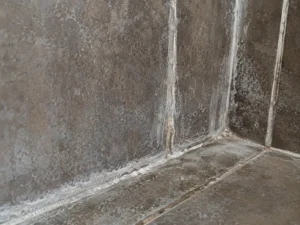
Hard water mineral buildup on tile and grout is common in Calgary bathrooms and showers.
How Hard Is Calgary’s Water, Exactly?
Water hardness is measured in milligrams per litre (mg/L) of calcium carbonate. The general scale looks like this:
| Hardness Level | mg/L Range |
|---|---|
| Soft | 0–60 mg/L |
| Moderately hard | 61–120 mg/L |
| Hard | 121–180 mg/L |
| Very hard | 181 mg/L and above |
Calgary’s water sits at approximately 220 mg/L on average — nearly twice the lower threshold for “hard” water, and well into the “very hard” range during winter months when river flows are lower and mineral concentrations rise.
Where you live in Calgary also matters. The city draws water from two separate rivers through two separate treatment plants:
- North Calgary (Bearspaw plant, Bow River): hardness ranges from roughly 126–198 mg/L
- South Calgary (Glenmore plant, Elbow River): hardness ranges from roughly 181–262 mg/L
That means south Calgary homeowners — in communities like Evergreen, Signal Hill, Mahogany, and McKenzie Towne — are often dealing with the hardest water in the city. Hardness peaks between December and February, which happens to coincide with the period when road salt and grit are being tracked inside daily.
The combination is genuinely rough on tile floors.
What Hard Water Actually Does to Your Grout
Here’s the mechanism most people don’t know:
Grout is a porous, cement-based material. Under a microscope, it looks more like compacted sand than a solid surface — full of tiny pores and channels that absorb liquid. That’s by design; grout is meant to flex slightly with temperature and movement, and porosity is part of what makes it do that.
The problem is that every drop of water that touches unsealed grout carries dissolved calcium and magnesium into those pores. When the water evaporates — which it does quickly in Calgary’s dry climate — the minerals are left behind as tiny crystalline deposits inside the grout.
Each mopping adds another layer.
Over months and years, these mineral deposits accumulate into what tile professionals call limescale — a chalky, hard coating that sits inside and on top of the grout surface. It does three specific things that make your floors look worse over time:
1. It creates a chalky grey haze. Light-coloured grout takes on a dull, cloudy appearance. Dark grout loses contrast with the tile.
2. It acts like a primer for other soils. Limescale has a rough, textured surface at the microscopic level — a perfect substrate for cooking grease, soap residue, and organic matter to bond to. Once grease attaches to mineral deposits inside the grout pores, a mop doesn’t stand a chance.
3. It makes the grout more porous over time. As mineral crystals expand and contract with temperature changes — something that happens frequently in Calgary given the temperature swings between inside and outside — they can physically widen the pore structure of the grout, making it even more absorbent. This is a slow process, but it’s one reason grout that’s never been maintained starts looking worse each year rather than staying the same.
Then Come the Calgary Winters
Hard water alone would be manageable. What makes Calgary tile floors particularly punishing is what happens from roughly October through April.
Calgary roads are treated with a combination of road salt, sodium chloride, and other de-icing compounds throughout winter. Every time someone walks through a treated parking lot, a salted sidewalk, or a slushy street and then steps into your home, they’re importing a fine residue of salt crystals, grit, and sand.
This matters for grout in two ways:
Salt is mildly corrosive to unsealed grout. Sodium chloride is the same compound that accelerates rust on steel and slowly eats at concrete bridge structures. In grout, it doesn’t cause dramatic visible damage quickly, but regular exposure over several winters gradually weakens the surface layer — making the grout slightly more porous each year and more vulnerable to the hard-water mineral cycle described above.
Grit acts as an abrasive. The fine sand and rock particles tracked in from outside are harder than most grout. When they’re trapped in grout lines and walked over repeatedly, they function like very fine sandpaper — slowly abrading the surface and, again, making the grout more porous and more receptive to staining.
And here’s the part most homeowners don’t expect: mopping spreads this contamination rather than removing it. A standard mop picks up some surface material, but it also pushes diluted grit, salt, and mineral residue into every low point on your floor — which is exactly where the grout lines are.
Why Vinegar and DIY Solutions Don’t Solve This
There’s a lot of advice online about using white vinegar or baking soda to clean grout. For light, recent surface staining, these can help temporarily. But for the specific combination of mineral buildup and tracked-in winter contamination that Calgary floors deal with, they have real limitations.
Vinegar (acetic acid): Effective at dissolving mineral deposits — limescale will react to mild acid. The problem is that grout is a cement-based material, and cement is also acid-sensitive. Regular use of vinegar on unsealed grout gradually etches and weakens the surface. You may be removing mineral buildup on one hand while accelerating surface degradation on the other.
Baking soda / scrubbing pastes: These work mechanically — the mild abrasive action lifts surface soil. But for contamination that’s worked itself into the pore structure of the grout, surface scrubbing doesn’t reach it. You’re cleaning the top layer and leaving everything below it in place.
Steam mops (consumer grade): Better than a standard mop, but the pressure and temperature are limited compared to truck-mounted professional equipment. Consumer steam mops also don’t extract — they apply steam and wipe, which still leaves a significant portion of loosened soil behind.
The consistent result of all these approaches is grout that looks slightly better immediately after cleaning and returns to its previous state — or worse — within a few days. This is the cycle most Calgary homeowners are stuck in.
What Actually Works: Extraction-Based Cleaning
The method that genuinely resets grout contaminated by hard water and winter grit is hot-water extraction — the same core process used in professional carpet cleaning, applied specifically to tile and grout.
Here’s what makes it different:
Professional truck-mounted equipment delivers heated water under controlled high pressure directly into the grout pore structure. Simultaneously, a powerful extraction system removes the water along with everything it’s loosened — mineral deposits, grease, salt, organic soil — before it can dry back into the grout.
The key difference from any consumer method is the extraction step. You’re not just cleaning the surface and leaving the contaminated water to evaporate back in. You’re physically removing the contamination from the floor.
For grout that has significant mineral buildup, a pre-treatment step is also applied — a solution that breaks down the calcium and magnesium bonds before extraction begins. This is what allows the process to restore grout that looks permanently discoloured rather than just clean-looking grout that was lightly soiled.
The practical result for most Calgary homeowners who’ve had it done: grout that returns to a colour close to its original installed appearance, and tile surfaces that look noticeably brighter.
Truck-mounted tile and grout cleaning helps remove soil, buildup, and residue from grout lines in Calgary homes.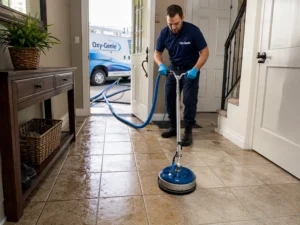
After Cleaning: Should You Seal Your Grout?
This is where a lot of homeowners make a decision they later regret — either skipping sealing entirely or sealing before the grout has been properly cleaned.
Grout sealing is only effective if it’s applied to grout that’s been thoroughly cleaned first. Sealing over grout that still has mineral deposits or organic soil locked in the pores doesn’t protect the grout — it traps the contamination inside and makes future cleaning harder.
Done in the right order — clean first, then seal — a penetrating grout sealer does something important: it fills the pore structure of the grout with a barrier that water and dissolved minerals can’t penetrate. This doesn’t mean your grout becomes impervious to everything, but it changes the dynamic significantly. Instead of every mop application depositing more calcium and magnesium into the grout, the minerals stay on the sealed surface where they can be wiped away.
For Calgary specifically, sealing makes the most practical difference in:
- Shower enclosures — constant hard-water exposure, daily humidity, soap residue
- Kitchen floors around the sink and cooking area — combination of grease and mineral deposits
- Entryways and mudrooms — ground zero for winter road salt and grit
The honest caveat: grout sealer is not permanent. A penetrating sealer in a high-traffic area needs to be reapplied every two to three years, or sooner if you start seeing water absorb into the grout rather than beading on the surface. A simple test — drop a few drops of water onto the grout. If it beads up, the sealer is working. If it soaks in immediately, the sealer has worn through.
What You Can Do Between Professional Cleanings
Professional extraction doesn’t need to happen every month. For most Calgary homes, once a year is appropriate — twice a year for showers or homes with pets and heavy kitchen use. Between visits, a few habits make a meaningful difference:
Switch your mop solution. Use a pH-neutral cleaner designed specifically for tile and grout — not a general floor cleaner, not vinegar. The goal is to clean without depositing new residue or accelerating mineral bonding. Change the mop water frequently; a dirty mop spreading diluted contamination around a floor is worse than not mopping at all.
Vacuum or dry sweep before mopping. This is the step most people skip, and it matters. If you mop over loose grit and salt crystals, you’re pushing them into grout lines rather than removing them. A quick dry pass first keeps the contamination from being worked in deeper.
Put a proper mat at your entry. A high-quality absorbent mat outside — or at minimum, inside — the main entry door captures a significant percentage of the salt and grit that would otherwise make it to your tile floor. During Calgary winter, this is genuinely one of the most effective things you can do for your grout.
Don’t let spills sit. Cooking oils and food acids bond to mineral deposits quickly. A spill wiped up within a few minutes is a surface cleanup; the same spill left for an hour has started to work into the grout pores.
Do the water-drop test every 6 months. Drop a small amount of water onto grout in a high-use area. If it soaks in within a few seconds, your sealer has worn through and it’s time to either reseal or book a professional clean-and-seal service.
Frequently Asked Questions
Why does my grout look dirty right after I mop?
This is the most common complaint we hear from Calgary homeowners. The most likely cause is a combination of hard-water mineral deposits already embedded in the grout and mop water that redistributes rather than removes them. When the mop water dries, the minerals and loosened soil settle back into the grout, often looking worse than before. The fix is extraction-based cleaning rather than surface mopping.
Will bleach clean hard-water deposits from grout?
Bleach is effective for organic staining like mould and mildew, but it doesn’t dissolve mineral deposits — calcium and magnesium are not organic compounds. If your grout looks grey or chalky, bleach will disinfect it but won’t change the colour. Mineral deposits require an acid-based or chelating pre-treatment followed by extraction.
Is Calgary’s hard water actually damaging my grout structurally?
Over a long period, yes — but this is usually a very slow process measured in years rather than months. The more immediate problem is aesthetic: the grout looks discoloured and dirty. The structural concern becomes more relevant if grout is also being exposed to road salt regularly in entryways and has never been sealed, since the combination of salt and mineral crystallization can gradually widen pores and weaken the surface.
How do I know if my grout has been sealed?
The water-drop test: put a few drops of water directly on the grout and wait 30 seconds. If the water beads up and sits on the surface, the grout is sealed. If it soaks in quickly, either it was never sealed or the sealer has worn through.
Can I seal the grout myself?
Yes — consumer penetrating grout sealers are widely available and relatively straightforward to apply. The important caveat is that sealing should only be done after the grout has been properly cleaned. Sealing dirty grout traps contamination inside and makes future cleaning much harder. If your grout hasn’t been professionally cleaned in several years, book that first, then seal.
How often should Calgary homeowners have their tile professionally cleaned?
Once a year is a reasonable baseline for most rooms. Shower enclosures and busy kitchens benefit from twice a year. If you have pets, young children, or your home gets heavy entryway traffic during winter months, more frequent cleaning may make sense. Calgary’s hard water and long winter season put tile floors under more stress than in cities with softer water.
Conclusion
The reason your grout keeps looking dirty in Calgary isn’t a mystery once you understand what’s actually happening. You’re cleaning with water that deposits minerals into the most porous surface in your home, while also tracking in months of road salt and grit every winter. The mop addresses neither problem at its source.
The reset is professional extraction — cleaning that goes into the pore structure of the grout rather than across the surface. Followed by sealing, it changes the maintenance equation: instead of depositing more mineral film every time you clean, you’re washing off a surface that resists absorption.
→ Find out more about Oxy-Genie’s tile and grout cleaning service in Calgary — including pricing and same-day availability
Call or text Ken directly: 403-452-4644
Ken Marcus has operated Oxy-Genie in Calgary since 2007, providing tile and grout cleaning, carpet cleaning, and upholstery cleaning for Calgary homeowners and businesses. All tile cleaning follows IICRC Standards-guided best practices.
